The project
2024 – 2025: Houses for all
Denmark: NEXT TVET (Copenhagen) and Rybners TVET (Esbjerg) Kenya: Comboni Polytechnic, Gilgil, Nakuru Funded by GLOBUS (Ministry of Foreign Affairs)
Apprentices can gain valuable experience in the Global South
A new take on the journeyman's travels
In the old days, when craftsmen completed their apprenticeship and became journeymen, they set off on foot with their certificate of training, a knapsack, a walking stick known as a Ziegenhainer, and a sword. They went "on the Walz," as it was called, often to Central Europe.
Back then, it was common to travel alone. Today, this can be compared to the exchange trips that take place within upper secondary education – typically the gymnasium (high school). But now the idea has begun to spread to vocational education. Here, students work with something tangible – a "common third," or fixed point, as cultural sociologist Iben Jensen calls it – which in many ways engages young people more, because what they talk about often becomes very concrete and shared.
Today, in a more globalised world, a more natural way to travel is to go further afield – while also working more sustainably on the projects, and being inspired by other cultures.
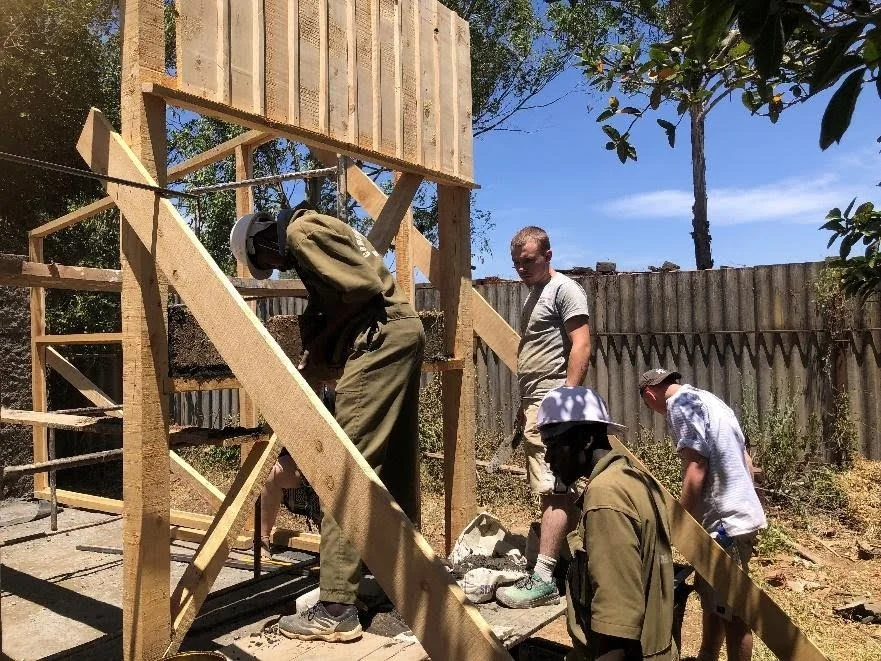
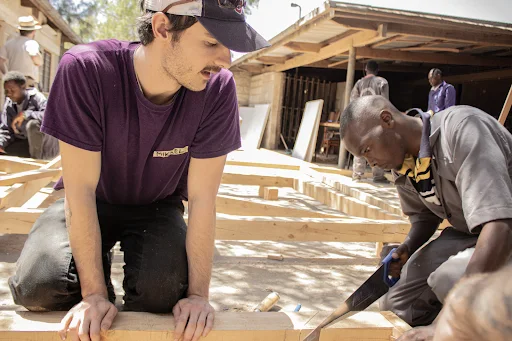
In early spring, for example, a group of young carpentry apprentices from NEXT in Copenhagen and bricklaying apprentices from Rybners in Esbjerg went on an exchange to Kenya to build a house together with Kenyan apprentices from Comboni Polytechnic in Gilgil, between Naivasha and Nakuru.
The Danish students and teachers spent 10 days with Kenyan apprentices and teachers, discovering both the differences and similarities between Danish and Kenyan culture through different building methods, materials and ways of understanding sustainability. In Kenya, materials are scarce and expensive, so absolutely everything is used. This saves a great deal of material compared to a Danish building site. In Denmark, on the other hand, when we talk about sustainability, we focus strongly on how different materials harm the environment.
Two vocational schools working together
As early as 2023, NEXT and Rybners in Esbjerg worked together to renovate a school in an informal settlement alongside Kenyan students from a vocational school, Comboni Polytechnic. We gained very good experience from working with a vocational school in Kenya that worked in a different way, but where our Danish students got along well socially and both sides could exchange experiences and ideas about sustainable construction.
The experience from that project has been carried forward into the new Houses for All, where students from Denmark and Kenya work together to develop and build an affordable, sustainable and practical house that others in Kenya can benefit from.
Students become engaged and inspired
Eight students and two teachers from NEXT in Copenhagen took part, along with six students and one teacher from Rybners in Esbjerg. A journalist, a construction architect and a coordinator also joined the trip.
Christian Hassing from Rybners in Esbjerg: I chose to sign up for the project to get an experience for life, get to know a completely new culture and learn a lot about their approach to work and building style. I went down there expecting and hoping to learn a lot about their techniques and methods – and that's exactly what I brought home with me.
The trip was planned with days spent working on the house, as the professional part, as well as days experiencing Kenyan culture and wildlife.
On the professional side, he says:
It's important to use the things we have available, and not to throw out materials that could easily be reused or used for something else just because they're a little damaged. I've gained a completely different approach to sustainability after this trip and experience.
Benjamin Damsgaard: I think it's great to see how skilled they [the Kenyans] are with hand tools, and how much they reuse their materials – we could learn more from that.
Another participant, Rasmus Tøtrup from Rybners in Esbjerg, writes: "Sustainable construction in Kenya is very much about minimising environmental impact. This includes using local materials such as clay, dung, grass and stone, which helps reduce transport costs and the carbon footprint. They also use natural ventilation in buildings."
Finally, Christian Hassing writes: Professionally, I probably got the most out of learning about their building methods and their use of materials and tools. Their approach to work was very relaxed and sometimes seemed unprepared and confusing, but somehow everything came together, and all tasks were completed on time and in the best possible way. I was very surprised by how well they communicate while they work, and how hard their work is compared to ours.
Our approach is more prepared and structured. We make an overall plan from the start and follow it, and if something goes wrong, we find it harder to come up with a quick solution. The Kenyans, on the other hand, just quickly come up with another solution.
Listen to Kenyan experience
The Danish teachers describe the difference in how Danes and Kenyans understand sustainability. It turned out that the idea of an affordable house did not hold up – the house would be far too expensive for a poor family. Sustainability may instead show up in certain details, such as the use of alternative materials for bricks. Timber can be expensive, as the team only used new wood. Used timber was not reused as much as the Danish teachers had expected, but the alternative ways of making bricks became quite popular during the building process.
The message to other vocational schools is: Spend more time, both on preliminary research and on communication (online) between the teachers involved before they meet.
It is important to talk not only about what succeeds, but also about the bumps along the way. "We need to listen more to what the Kenyans have to offer," as one of the teachers put it.
The house as inspiration for others
Although the house was not fully completed, and the Danish participants were only in Kenya for 10 days, the foundation was built – raised high so that water cannot seep into the house. The walls are built around a timber frame, filled in with bricks made from new sustainable materials such as straw and sawdust.
Advice for other vocational schools
- Make sure the entire management is on board with the project, and that it can be integrated across the whole school as part of its profile.
- Create a realistic budget for the exchange. Beware of underbudgeting.
- Ensure firm management of the budget and time set aside for it, so those working on the professional content have time for their part.
- Prepare thoroughly, and feel free to contact others who have done similar trips.
- Choose teachers who are passionate about developing their subject and also open to being inspired by meeting another culture.
- Set criteria for selecting students: professional skills, curiosity, engagement and openness to another culture.
- If there is a reciprocal visit from the Global South, make sure visas can be granted, and also take steps to prevent participants from absconding to Europe – for example, by ensuring they do not have family in Europe.
- Give participants a leaflet with all the necessary information before they travel to the Global South.
- Make sure there are students who are willing to share and communicate about the project afterwards.